
Close Menu
NewsDesk

    Subscribe to Updates

    Get the latest creative news from FooBar about art, design and business.

    What's Hot

    South Africa set to open first underground gold mine in 15 years

    August 22, 2025

    China’s critical minerals chokehold sparks Quad action

    August 21, 2025

    Inside Australia’s billion-dollar bid to take on China’s rare earth dominance

    August 21, 2025
    TRENDING -
    • South Africa set to open first underground gold mine in 15 years
    • China’s critical minerals chokehold sparks Quad action
    • Inside Australia’s billion-dollar bid to take on China’s rare earth dominance
    • Zambia dismisses US health warning after toxic spill in copper mining area
    • Gold rush could bring open pit mines to Black Hills in South Dakota, but extraction could forever change region
    • US appeals court puts the brakes on contested land transfer for Arizona copper mine
    • Sustainable use of coal important for energy transition – FutureCoal
    • Deep-sea mining is a false solution to our challenges
    NewsDesk
    • Home
    • Critical Materials
    • Environment
    • Global Policy
    • Mining
    NewsDesk
    Home»Environment»Blue whales have gone silent. Why that has scientists worried about Earth’s biggest animals … and the ocean

    Blue whales have gone silent. Why that has scientists worried about Earth’s biggest animals … and the ocean

    NewsDeskBy NewsDeskAugust 14, 2025No Comments4 Mins Read
    Facebook Twitter Pinterest LinkedIn Tumblr Reddit Telegram Email
    Share
    Facebook Twitter LinkedIn Pinterest Email

    [ad_1]

    Your assist helps us to inform the story

    From reproductive rights to local weather change to Large Tech, The Impartial is on the bottom when the story is creating. Whether or not it is investigating the financials of Elon Musk’s pro-Trump PAC or producing our newest documentary, ‘The A Phrase’, which shines a light-weight on the American ladies preventing for reproductive rights, we all know how necessary it’s to parse out the information from the messaging.

    At such a vital second in US historical past, we’d like reporters on the bottom. Your donation permits us to maintain sending journalists to talk to either side of the story.

    The Impartial is trusted by Individuals throughout all the political spectrum. And in contrast to many different high quality information retailers, we select to not lock Individuals out of our reporting and evaluation with paywalls. We consider high quality journalism ought to be out there to everybody, paid for by those that can afford it.

    Your assist makes all of the distinction.

    Blue whales — the most important animals on Earth — aren’t singing as a lot anymore, and that is obtained scientists concerned.

    A study published in PLOS analyzing six years’ value of acoustic knowledge collected from the ocean’s floor discovered that blue whale vocalizations have been reducing because the animal’s meals sources have disappeared.

    The monitor — a hydrophone sitting on the ocean flooring off the coast of California — collected sounds from the assorted creatures within the ocean, together with a number of whale species.

    By coincidence, the recordings started throughout a marine heatwave that’s unprecedented in fashionable occasions. In accordance with the examine, the heatwave lowered the quantity of krill out there for blue whales to devour. Because the krill disappeared, so too did the blue whale songs.

    Over the course of the acoustic assortment, blue whale songs deceased by roughly 40 p.c.

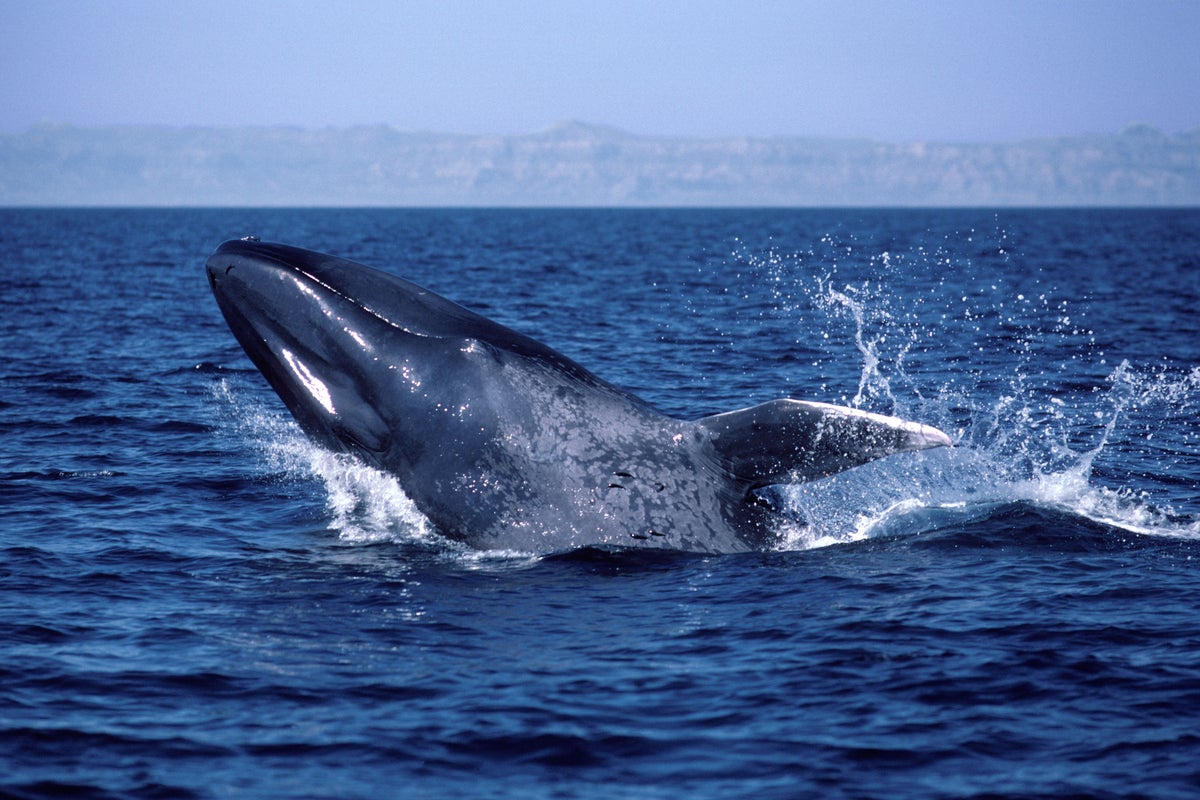
    A breaching blue whale. Blue whale songs off the coast of California have reportedly dropped by roughly 40 p.c as their major meals supply – krill – have develop into extra scarce on account of rising ocean temperatures ((Alamy/PA))

    “While you actually break it down, it’s like making an attempt to sing when you’re ravenous,” John Ryan, a organic oceanographer on the Monterey Bay Aquarium Analysis Institute informed National Geographic. “They have been spending all their time simply looking for meals.”

    The marine heating occasion started in 2013, when a cussed, dense pool of sizzling water — later dubbed “The Blob” — moved from the Bering Sea and the Gulf of Alaska down the North American coast.

    In some locations the ocean temperatures have been greater than 4.5 Fahrenheit above common because of the heating. The Blob grew and lined a 500 mile broad and 300 toes deep area within the Pacific Ocean. By 2016, it lined roughly 2,000 miles of the Pacific Ocean.

    The rise in temperature allowed for poisonous algae blooms that killed off krill — tiny, shrimp like creatures — and different marine life.

    “When we’ve these actually sizzling years and marine heatwaves, it’s extra than simply temperature,” Kelly Benoit-Hen, a Monterey Bay Aquarium marine biologist and co-author of the paper informed Nationwide Geographic. “The entire system adjustments, and we don’t get the krill. So the animals that rely solely on krill are type of out of luck.”

    The blue whales have been amongst these animals who have been out of luck. They feed on densely packed krill — their large mouths soak up 1000’s of gallons of water directly, sucking in huge numbers of the tiny creatures — however with out krill current, they went hungry.

    Ryan stated the whales have stopped singing as a result of they’re “spending all their vitality looking” for meals.

    “There’s simply not sufficient time left over—and that tells us these years are extremely disturbing,” he stated.

    Local weather change, pushed by the human burning of fossil fuels, will solely make the scenario worse, the researchers warn. The world’s oceans already take in greater than 90 p.c of the surplus warmth from local weather change.

    “There are complete ecosystem penalties of those marine warmth waves,” continues Benoit-Hen. “If they cannot discover meals, and so they can traverse all the West Coast of North America, that could be a actually large-scale consequence.”

    This text has been amended to appropriately determine that “The Blob” moved from the Bering Sea and the Gulf of Alaska down the North American coast

    [ad_2]

    Source link

    Share. Facebook Twitter Pinterest LinkedIn Tumblr Email
    NewsDesk
    • Website

    Related Posts

    Zambia dismisses US health warning after toxic spill in copper mining area

    August 21, 2025

    Gold rush could bring open pit mines to Black Hills in South Dakota, but extraction could forever change region

    August 21, 2025

    Sustainable use of coal important for energy transition – FutureCoal

    August 21, 2025
    Don't Miss

    South Africa set to open first underground gold mine in 15 years

    Top Stories August 22, 2025

    South Africa is set to open its first new underground gold mine in 15 years…

    China’s critical minerals chokehold sparks Quad action

    August 21, 2025

    Inside Australia’s billion-dollar bid to take on China’s rare earth dominance

    August 21, 2025

    Zambia dismisses US health warning after toxic spill in copper mining area

    August 21, 2025
    Our Picks

    South Africa set to open first underground gold mine in 15 years

    August 22, 2025

    China’s critical minerals chokehold sparks Quad action

    August 21, 2025

    Inside Australia’s billion-dollar bid to take on China’s rare earth dominance

    August 21, 2025

    Zambia dismisses US health warning after toxic spill in copper mining area

    August 21, 2025
    About Us

    Newsdesk is the #1 source for accurate and timely information about critical materials, the mining industry and how they impact the environment, world economies and strategic defense.

    Our Picks

    AI Foundation Models Drive Breakthroughs in Battery Materials

    August 14, 2025

    Trigg Minerals snaps up 20 mining claims in Antimony Canyon, US

    August 19, 2025

    In-situ leaching: a cleaner, greener, cheaper way to mine

    August 12, 2025
    Don't Miss

    The Roadmap To Opening A Mine

    August 12, 2025

    Underground development mining: A portal to unlocking hidden resources – Hexagon

    August 16, 2025

    Mineral Processing Part 1 | Geology for Investors

    August 12, 2025
    Copyright © 2025 Newsdesk.news All Rights Reserved.

    Type above and press Enter to search. Press Esc to cancel.